
The United States remains the most competitive pharmaceutical market globally. High R&D investment, strict regulatory oversight, and increasing digital consumption among both healthcare professionals (HCPs) and patients have transformed how pharmaceutical brands approach marketing.
Digital marketing in the U.S. pharma sector is not simply about visibility. It requires regulatory precision, medical accuracy, ethical promotion, and measurable outcomes. Any strategy that ignores compliance or patient trust risks regulatory action and reputational damage.
Regulatory Foundations: FDA, FTC, and Compliance Requirements
Pharma digital marketing in the U.S. operates under the oversight of the U.S. Food and Drug Administration (FDA) and the Federal Trade Commission (FTC).
FDA Guidelines for Prescription Drug Promotion
The FDA’s Office of Prescription Drug Promotion (OPDP) regulates how prescription drugs are advertised. Key principles include:
Fair balance between benefits and risks
Substantiated claims backed by clinical evidence
Clear disclosure of side effects
No misleading superiority claims
All website copy, landing pages, paid ads, and social content must reflect these standards.
Fair Balance and Risk Disclosure
Digital environments pose unique challenges for fair balance, particularly in paid search and social media ads with character limits. Risk information must be presented with comparable prominence to benefit claims.
This directly aligns with Google’s emphasis on trust and reliability in high-stakes categories such as health, where strong E-E-A-T signals are essential.
Audience Segmentation in U.S. Pharma Marketing
Effective pharma digital marketing begins with clear segmentation.
HCP vs DTC Campaigns
Pharmaceutical companies typically operate in two primary streams:
Healthcare Professional (HCP) Marketing
Focused on physicians, pharmacists, nurse practitioners
Channels: medical journals, programmatic display, LinkedIn, gated clinical content
Direct-to-Consumer (DTC) Marketing
Patient education and awareness
Channels: search engines, social media, condition-based content hubs
Each requires different messaging tone, compliance structure, and content depth.
Payers and Institutional Stakeholders
Market access teams increasingly use digital platforms to communicate real-world evidence (RWE), health economics data, and formulary value propositions to payers.
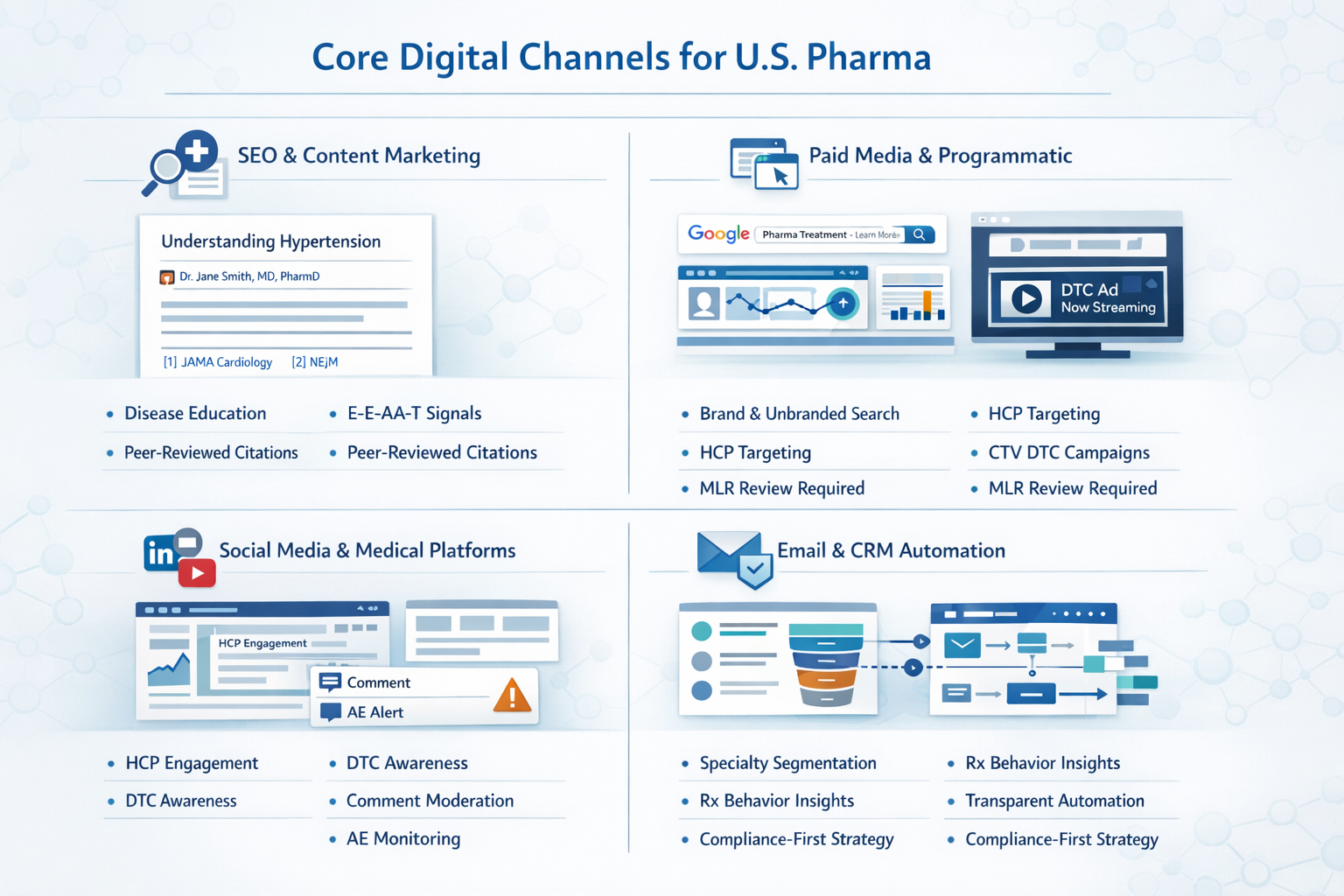
Core Digital Channels for U.S. Pharma
SEO and Content Marketing
Organic search is critical for disease awareness, branded search defense, and competitive positioning.
Google’s guidance emphasizes rewarding high-quality, people-first content demonstrating expertise and trust .
For pharma, this means:
Medically reviewed articles
Author bylines with credentials
Citations from peer-reviewed journals
Transparent sourcing
Clear authorship and editorial processes
SEO in pharma must prioritize:
Disease state education
FAQ-rich content
Structured data implementation
Technical crawlability
Paid Media and Programmatic Advertising
Key paid channels in U.S. pharma include:
Google Search Ads (brand and unbranded terms)
Programmatic display targeting HCP databases
Connected TV (CTV) for DTC campaigns
Sponsored placements in medical platforms
All creatives must pass internal Medical-Legal-Regulatory (MLR) review.
Social Media and Medical Platforms
Platforms such as LinkedIn are effective for HCP engagement, while Meta and YouTube support DTC awareness campaigns. Comment moderation and adverse event monitoring must be integrated.
Email and CRM
CRM systems allow segmentation by specialty, prescription behavior, and engagement history. Automation must be compliant and transparent, consistent with Google’s stance that automation is acceptable when not used to manipulate ranking .
E-E-A-T in Pharma Content Strategy
Healthcare is a “Your Money or Your Life” (YMYL) category. Google’s quality systems place stronger emphasis on trust and reliability in health-related topics .
Pharma websites should clearly answer:
Who wrote this content?
What are their credentials?
How was the content reviewed?
Why was it created?
This aligns with the “Who, How, Why” framework emphasized in Google’s helpful content documentation .
AI and Automation in Pharma Marketing
AI can assist with:
Data analysis
Campaign optimization
Draft content creation
Audience segmentation
However, AI-generated content must still meet quality, originality, and compliance standards. Google does not penalize AI content by default; it evaluates quality and helpfulness .
In pharma, AI outputs must undergo:
Medical review
Fact verification
Regulatory approval
Automation cannot replace clinical accountability.
Data Privacy, HIPAA, and Martech Stack
U.S. pharma marketers must comply with:
HIPAA (Health Insurance Portability and Accountability Act)
State-level privacy laws (e.g., CCPA/CPRA)
Data transparency requirements
Tracking pixels, retargeting strategies, and data partnerships must be structured to protect patient data.
Recommended Martech components:
HIPAA-compliant CRM
Consent management platform
Marketing automation with audit trails
Secure analytics environment
Measuring Performance in a Regulated Environment
KPIs in pharma differ from standard e-commerce metrics. Common indicators include:
New prescription lift (NRx)
Total prescriptions (TRx)
Brand search volume
HCP engagement rates
Content dwell time
Market share changes
Given Google’s evolving AI search experiences, marketers should evaluate visit quality and engagement depth rather than clicks alone .
Common Pitfalls in U.S. Pharma Digital Marketing
Overemphasis on traffic instead of qualified engagement
Insufficient medical review processes
Lack of author transparency
Thin content targeting high-volume keywords
Overreliance on automation without editorial oversight
Google’s systems consistently reward original, high-quality content over scaled, low-value output .
Yes, but it must comply with FDA and FTC regulations, including fair balance and truthful claims.
Yes, provided the content is accurate, medically reviewed, and not created primarily to manipulate search rankings .
For medical content, clear authorship improves credibility and aligns with Google’s E-E-A-T principles.